

First Line of Defense

Along Georgia’s 100-mile coastline, an unsung guardian protects the region’s tourism, shipping, and fishing industries: native flora.
Barrier island ecosystems with their native grasses play a crucial role in buffering communities from destructive storms along the coastline. Yet development and severe weather events threaten to displace these coastal habitats and the plant species that hold them together.
Native coastal grasses are powerhouse plants that support wildlife, pollinators, and coastlines, says Jenny Cruse-Sanders, director of the State Botanical Garden of Georgia. Restoration efforts must consider the state’s coastal guardians.
“The kind of plant you use matters,” says Cruse-Sanders. “If you’re going to build a habitat that works harder and better, the species you use makes a difference.”
The State Botanical Garden of Georgia at the University of Georgia and the Jekyll Island Authority are partnering through the garden’s Georgia Native Seed Network to regrow native plants and restore the coast’s vital ecosystems.
“Investing in that is investing in the future of Georgia,” says Cruse-Sanders.
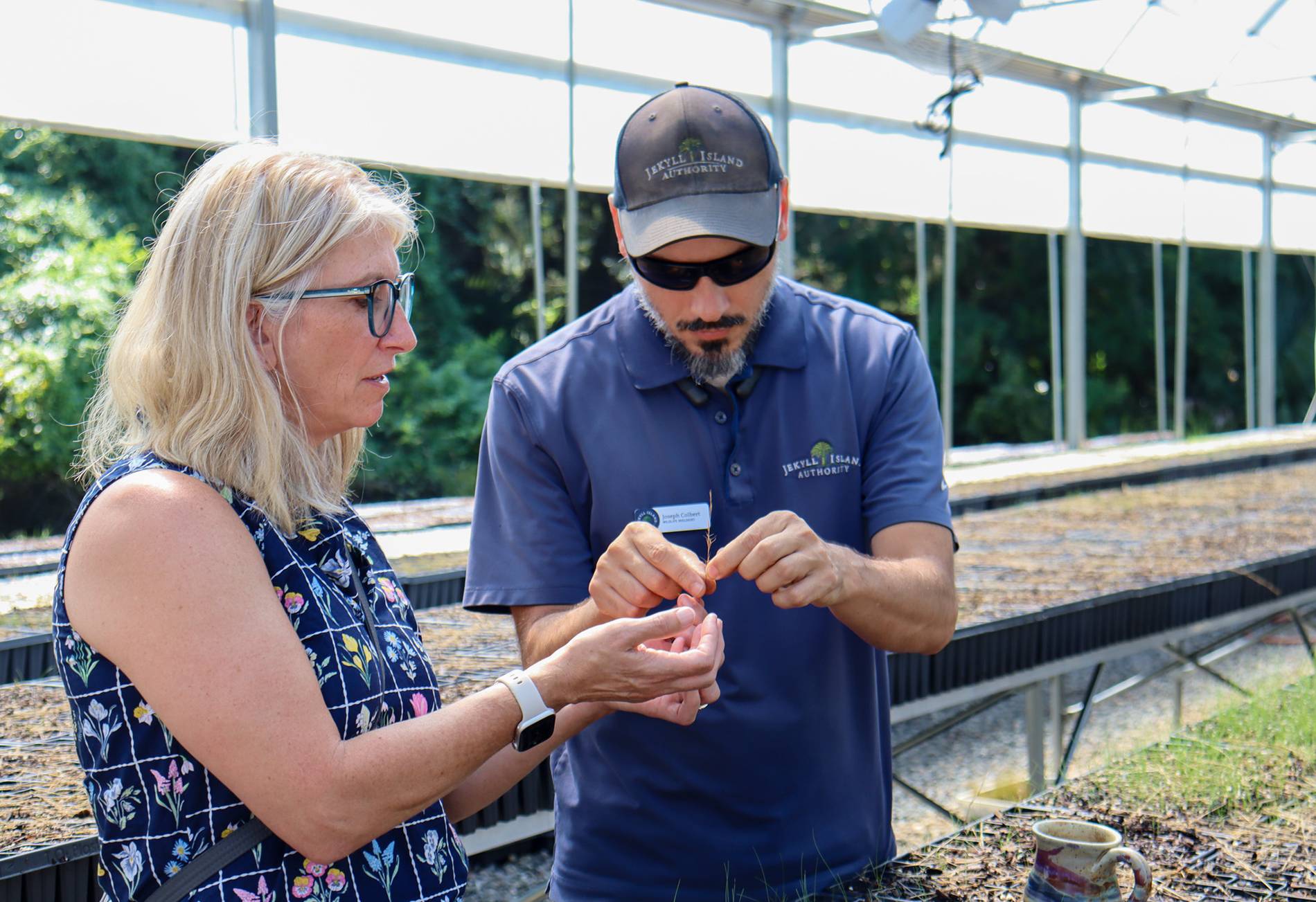
Jenny Cruse-Sanders, director of the State Botanical Garden of Georgia, and Joseph Colbert, a community wildlife biologist for Jekyll Island Authority, inspect seeds in the greenhouse on Jekyll Island.
Restoration in Progress
Historically, conservationists lacked the native plant seeds and materials to restore these lands.
Now, the State Botanical Garden is developing these resources in partnership with the Jekyll Island Authority’s conservation program and providing them to other regional partners.
A grant from the Georgia Outdoor Stewardship Program funded the construction of a greenhouse at Jekyll Island State Park to cultivate maritime grasses, including wiregrass, muhly grass, and broom sedges. Shanna Lee, the Georgia Native Seed Network technician stationed on the coast, has grown more than 170,000 plugs of native grasses for restoration projects.

Al Tate, a Jekyll Island volunteer, moves trays of wiregrass plugs to be planted in the wildlife corridor in the spring of 2026.
One of these projects is converting 126 acres of golf course land into a wildlife corridor of native grasses.
“There’s a human footprint on the island,” said Joseph Colbert, community wildlife biologist for Jekyll Island Authority. “We have areas that naturally should have maritime grasses that don’t.
Colbert says the project benefits wildlife and the Oleander golf course.
“It’s a win for the golf course,” he says, “because it reduces in-play areas, meaning less maintenance, and provides a more natural and striking landscape that will invite more recreational activities like walking and biking.”
Lee and a team of volunteers have already begun planting species at the site, installing 28,000 wiregrass plugs in the fall of 2025. Once established, the plants will stabilize soils, enhancing the island’s resilience to flooding and storm surge and providing food and shelter for wildlife.

Guided by Research
While the restoration project has become a point of pride for the community, the work is informed by previous research on Georgia’s barrier islands.

Shanna Lee adds seeds to her collection bag from native grasses growing on Jekyll Island.
With support from UGA Marine Extension and Georgia Sea Grant, researchers and land managers studied maritime grasslands on Little St. Simons Island and identified best practices for future management. These insights helped guide restoration efforts on Jekyll Island, highlighting how collaboration among scientists, conservation groups, and state agencies is key to restoring imperiled habitats in highly dynamic coastal areas.
“I feel like Jekyll is a pioneer in this whole process and concept of restoration,” says Stacia Hendricks, director of special projects for The Lodge on Little St. Simons Island. “I see it as something that will really lend to biodiversity and provide a huge benefit to people by virtue of clean water, clean air, and a greater number of living creatures.”

Written by: Laurel Clark
Photos by: Laurel Clark
Video by: Thomas Abercrombie
